Samples and Measurement#
In this tutorial, we will introduce how to use Quantax to generate samples.
In the beginning, we prepare ground states of transverse-field Ising models from which we will generate samples.
import numpy as np
import jax
import jax.numpy as jnp
import quantax as qtx
import matplotlib.pyplot as plt

lattice = qtx.sites.Square(4)

H0 = qtx.operator.Ising(h=1.0)
E0, wf0 = H0.diagonalize()
state0 = qtx.state.DenseState(wf0)

H1 = qtx.operator.Ising(h=3.0)
E1, wf1 = H1.diagonalize()
state1 = qtx.state.DenseState(wf1)

H2 = qtx.operator.Ising(h=10.0)
E2, wf2 = H2.diagonalize()
state2 = qtx.state.DenseState(wf2)
Exact sampler#
ExactSampler generates samples by sampling the full wavefunction. If the provided state is not a DenseState, it will generate a DenseState internally through forward pass. The sampler is defined below.
sampler0 = qtx.sampler.ExactSampler(state0, nsamples=1024)
sampler1 = qtx.sampler.ExactSampler(state1, nsamples=1024)
sampler2 = qtx.sampler.ExactSampler(state2, nsamples=1024)
Now we can generate samples.
samples0 = sampler0.sweep()
samples1 = sampler1.sweep()
samples2 = sampler2.sweep()

print(samples0)
print("spins shape", samples0.spins.shape)
print("psi shape", samples0.psi.shape)
Samples(spins=Array([[ 1,  1,  1, ...,  1,  1,  1],
       [ 1,  1,  1, ...,  1,  1,  1],
       [ 1,  1,  1, ...,  1,  1,  1],
       ...,
       [-1,  1,  1, ...,  1,  1,  1],
       [ 1,  1,  1, ...,  1,  1,  1],
       [ 1,  1,  1, ...,  1,  1,  1]], dtype=int8), psi=array([-0.82724601, -0.82724601, -0.10395364, ..., -0.01737325,
       -0.82724601, -0.10395365], shape=(1024,)), state_internal=None, reweight_factor=None)
spins shape (1024, 16)
psi shape (1024,)
The generated sample is a PyTree with 4 terms: spins, psi, state_internal, and reweight_factor. Beginners usually only need spins and psi, which correspond to the generated spin configurations \(s\) and their wavefunctions \(\psi(s)\). The probability of samples is given by \(|\psi(s)|^2\).
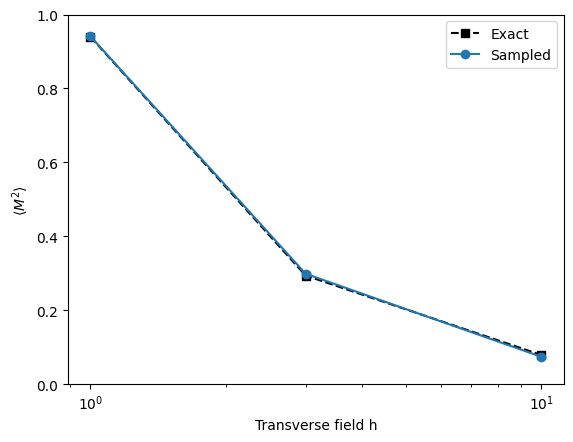
Let’s check how magnetization changes by looking at
from quantax.operator import sigma_z

N = lattice.Nsites
M = sum(sigma_z(i) for i in range(N)) / N
M2 = M @ M

h = [1.0, 3.0, 10.0]

exactM2 = np.array([state0 @ M2 @ state0, state1 @ M2 @ state1, state2 @ M2 @ state2])
sampledM2 = np.array([
    M2.expectation(state0, samples0),
    M2.expectation(state1, samples1),
    M2.expectation(state2, samples2),
])

plt.semilogx(h, exactM2, 'ks--', label='Exact')
plt.semilogx(h, sampledM2, 'o-', label='Sampled')
plt.xlabel('Transverse field h')
plt.ylabel(r'$\langle M^2 \rangle$')
plt.ylim(0, 1)
plt.legend()
plt.show()
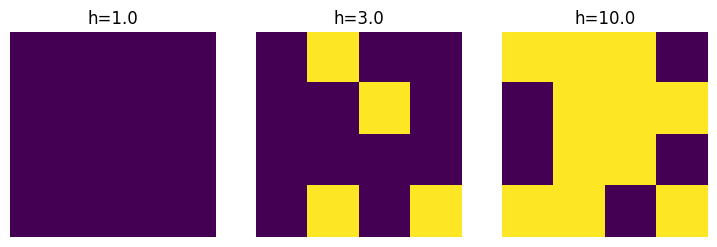
One can also show snapshots from generated samples.
fig, axes = plt.subplots(1, 3, figsize=(9, 3))

axes[0].imshow(samples0.spins[0].reshape(4, 4))
axes[0].axis('off')
axes[0].set_title("h=1.0")

axes[1].imshow(samples1.spins[0].reshape(4, 4))
axes[1].axis('off')
axes[1].set_title("h=3.0")

axes[2].imshow(samples2.spins[0].reshape(4, 4))
axes[2].axis('off')
axes[2].set_title("h=10.0")

plt.show()
Metropolis sampler#
ExactSampler in general cannot be used in large systems, in which case we need Metropolis samplers. Below we show how to create a LocalFlip sampler, which proposes new spin configurations by flipping spins locally.
Unlike ExactSampler, Metropolis samplers return Samples with psi=None. If the wavefunction amplitudes are needed, evaluate state(samples.spins).
sampler0 = qtx.sampler.LocalFlip(state0, nsamples=1024)
sampler1 = qtx.sampler.LocalFlip(state1, nsamples=1024)
sampler2 = qtx.sampler.LocalFlip(state2, nsamples=1024)
You might have noticed that it takes some time to construct the Metropolis sampler. It’s because the spins stored in the sampler are thermalized during initialization. You can manually set an argument thermal_steps=0 to initialize without thermalization, but please remember to thermalize spin configurations in the future.
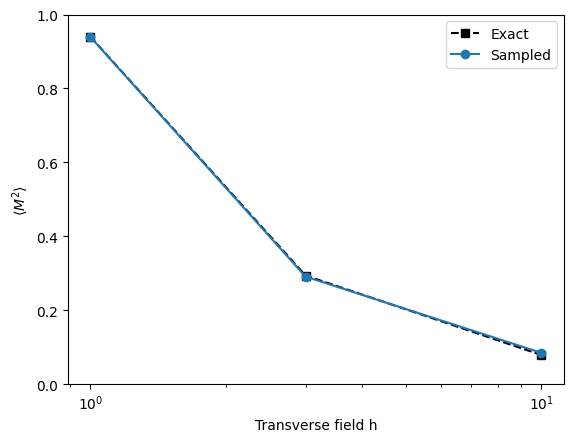
The magnetization can be measured similarly.
samples0 = sampler0.sweep()
samples1 = sampler1.sweep()
samples2 = sampler2.sweep()

exactM2 = np.array([state0 @ M2 @ state0, state1 @ M2 @ state1, state2 @ M2 @ state2])
sampledM2 = np.array([
    M2.expectation(state0, samples0),
    M2.expectation(state1, samples1),
    M2.expectation(state2, samples2),
])

plt.semilogx(h, exactM2, 'ks--', label='Exact')
plt.semilogx(h, sampledM2, 'o-', label='Sampled')
plt.xlabel('Transverse field h')
plt.ylabel(r'$\langle M^2 \rangle$')
plt.ylim(0, 1)
plt.legend()
plt.show()
By default, the initial thermalization takes 20 * N updates, and each sweep takes 2 * N updates. This is an empirical balance between efficiency and reliability. For better thermalization, one can specify thermal_steps and sweep_steps arguments in the initialization.
One can also customize Metropolis samplers by an inheritance of Metropolis. Here we show an example of defining a sampler that flips all spins in a lattice.
from functools import partial
from jaxtyping import Key


class FlipLattice(qtx.sampler.Metropolis):

    @partial(jax.jit, static_argnums=0)
    def propose(self, key: Key, old_spins: jax.Array):
        new_spins = -old_spins
        return new_spins
The sampler we just defined is obviously not ergodic. To make it work, we want to combine it with LocalFlip. This can be done as shown below.
sampler_local = qtx.sampler.LocalFlip(state1, nsamples=896, thermal_steps=0)
sampler_global = FlipLattice(state1, nsamples=128, thermal_steps=0)
sampler_mix = qtx.sampler.MixSampler([sampler_local, sampler_global])
sampler_mix generates 896+128=1024 samples per sweep. In each proposal, there is 896/1024 chance to update all spin configurations by LocalFlip, and 128/1024 to update by FlipLattice. Here we check the magnetization to verify that the generated samples are still correct.
samples = sampler_mix.sweep()

print("Exact magnetization for h=3.0:", state1 @ M2 @ state1)
print("Sampled magnetization for h=3.0:", M2.expectation(state1, samples))
Exact magnetization for h=3.0: 0.2938840985298157
Sampled magnetization for h=3.0: 0.29742431640625
Measurement#
Now we introduce how to use the generated samples to measure physical quantities.
As we have shown, one can call op.expectation(state, samples) to estimate the expectation value
\(\braket{\hat O}\) of an operator. To estimate the variance \(\braket{\hat O^2} - \braket{\hat O}^2\) at the same time, one can call
expectation, var = M2.expectation(state0, samples0, return_var=True)
print("h=1.0: <M2> =", expectation, "var(M2) =", var)
h=1.0: <M2> = 0.9392852783203125 var(M2) = 0.012899339199066162
As we know, the uncertainty of an observable \(O\) in Monte Carlo methods is
where \(N_s\) is the number of samples. Then we can estimate the uncertainty of the observable as
uncertainty = jnp.sqrt(var / samples0.nsamples)
print(f"h=1.0: <M2> = {expectation} ± {uncertainty}")
print("Exact M2 =", exactM2[0])
h=1.0: <M2> = 0.9392852783203125 ± 0.0035492267925292253
Exact M2 = 0.9399279952049255
Apart from observables, some other quantities are also important in quantum physics. An important one is the overlap (fidelity) between two states. One can rewrite it as
Here, we show the overlap between state0 and state1 as an example.
samples0 = sampler0.sweep()
samples1 = sampler1.sweep()

s0 = samples0.spins
psi_s0 = state0(s0)
phi_s0 = state1(s0)

s1 = samples1.spins
psi_s1 = state0(s1)
phi_s1 = state1(s1)

print("Estimated overlap: ", jnp.mean(phi_s0 / psi_s0) * jnp.mean(psi_s1 / phi_s1))
print("Exact overlap: ", abs(state0 @ state1) ** 2)
Estimated overlap:  0.15822542
Exact overlap:  0.11569184400656596
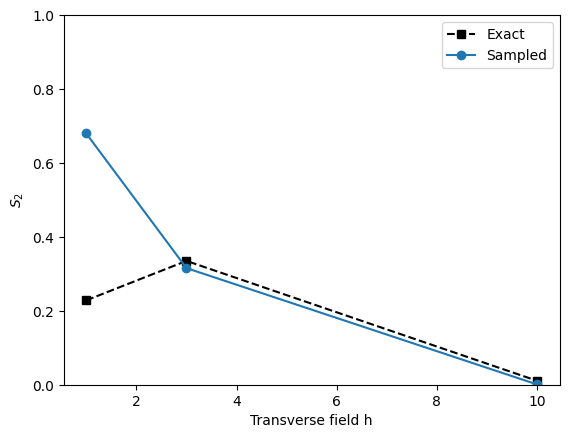
Another important quantity is the entanglement entropy. In VMC, it’s only convenient to compute the Rényi-2 entropy
when we split the whole system into two subregions A and B.
For a pure state \(\ket{\psi}\), matrix elements of \(\rho_A\) are given by $\( (\rho_A)_{s_A, s_A'} = \frac{\sum_{s_B} \psi(s_A, s_B) \psi^*(s_A', s_B)}{||\psi||^2}, \)\( where \)\ket{s} = \ket{s_A} \otimes \ket{s_B}$ splits a basis state into basis states in two subregions.
Then we can rewrite \(\mathrm{Tr}(\rho_A^2)\) into
Therefore, the entropy is $\( S_2(A, B) = -\log \left< \frac{\psi(s_A, s_B') \psi(s_A', s_B)}{\psi(s_A, s_B) \psi(s_A', s_B')} \right>_{s \sim |\psi|^2, s' \sim |\psi|^2}. \)$
Here, we show an example of entropy computation, where we split the whole lattice into A and B with equivalent sizes.
def entropy(state: qtx.state.State, samples: qtx.sampler.Samples):
    Lx, Ly = lattice.shape[1:]
    Ns = samples.nsamples
    spins = samples.spins.reshape(Ns, Lx, Ly)
    sA = spins[: Ns // 2, : Lx // 2]
    sB = spins[: Ns // 2, Lx // 2 :]
    sA_ = spins[Ns // 2 :, : Lx // 2]
    sB_ = spins[Ns // 2 :, Lx // 2 :]

    swap_s1 = jnp.concatenate([sA, sB_], axis=1).reshape(Ns // 2, -1)
    swap_s2 = jnp.concatenate([sA_, sB], axis=1).reshape(Ns // 2, -1)
    psi1 = state(swap_s1)
    psi2 = state(swap_s2)

    psi = state(samples.spins)
    ratio = (psi1 * psi2) / (psi[: Ns // 2] * psi[Ns // 2 :])
    Tr_rhoA2 = jnp.mean(jnp.asarray(ratio))
    entropy = -jnp.log(Tr_rhoA2)
    return entropy
samples0 = sampler0.sweep()
samples1 = sampler1.sweep()
samples2 = sampler2.sweep()

S0 = entropy(state0, samples0)
S1 = entropy(state1, samples1)
S2 = entropy(state2, samples2)
From the exact wavefunction, one can use QuSpin to compute the exact entropy.
basis = state0.basis

S0_exact = basis.ent_entropy(state0.psi, density=False, alpha=2.0)["Sent_A"]
S1_exact = basis.ent_entropy(state1.psi, density=False, alpha=2.0)["Sent_A"]
S2_exact = basis.ent_entropy(state2.psi, density=False, alpha=2.0)["Sent_A"]

plt.plot(h, [S0_exact, S1_exact, S2_exact], 'ks--', label='Exact')
plt.plot(h, [S0, S1, S2], 'o-', label='Sampled')
plt.xlabel('Transverse field h')
plt.ylabel(r'$S_2$')
plt.ylim(0, 1)
plt.legend()
plt.show()