Neural Jastrow#
In this tutorial, we use neural networks as generalized Jastrow factors to study the Heisenberg J1-J2 model.
Reference:
import matplotlib.pyplot as plt
import jax.numpy as jnp
import quantax as qtx
from IPython.display import clear_output

qtx.set_default_dtype(jnp.float64)

lattice = qtx.sites.Square(4, Nparticles=(8, 8))
The Hamiltonian is
where \(\braket{ij}\) and \(\braket{\braket{ij}}\) represent nearest and next-nearest neighbors, respectively.
from quantax.symmetry import Identity, TransND, C4v, SpinInverse

H = qtx.operator.Heisenberg(J=[1, 0.5], n_neighbor=[1, 2])

full_symm = TransND() @ C4v() @ SpinInverse()
E, psi = H.diagonalize(symm=full_symm)
exact_energy = E[0]
exact_state = qtx.state.DenseState(psi, full_symm)
print("Exact ground state energy:", exact_energy)
/home/aochen/quantax/quantax/symmetry/symmetry.py:330: GeneralBasisWarning: using non-commuting symmetries can lead to unwanted behaviour of general basis, make sure that quantum numbers are invariant under non-commuting symmetries!
  basis = spin_basis_general(
Exact ground state energy: -33.831693405579394
Gutzwiller-projected fermionic wavefunction#
The Hamiltonian in spin degrees of freedom can be mapped to fermion ones by
where \(\alpha = x,y,z\) and \(\sigma^\alpha\) are Pauli matrices. Quantax utilizes this relation internally such that fermionic mean-field states can be optimized in spin systems.
A fermionic wavefunction \(\ket{\psi_0}\) contains redundancy of zero occupancy and double occupancy when it is used for spin systems. Therefore, one needs a Gutzwiller projection to obtain
where \(\hat P_G = \prod_i (n_{i\uparrow} - n_{i\downarrow})^2\) projects the state to spin degrees of freedom. In variational Monte Carlo, this is done by sampling suitable sectors instead of modifying the mean-field state.
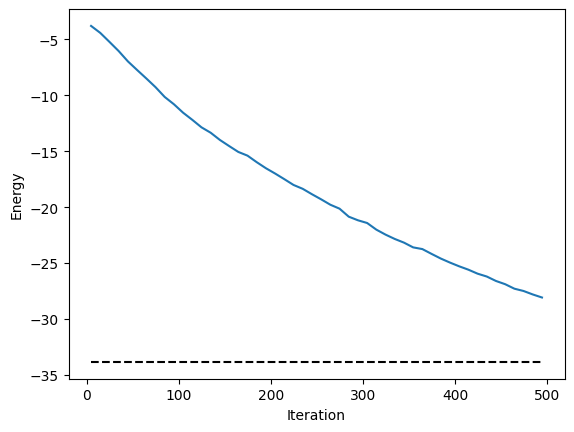
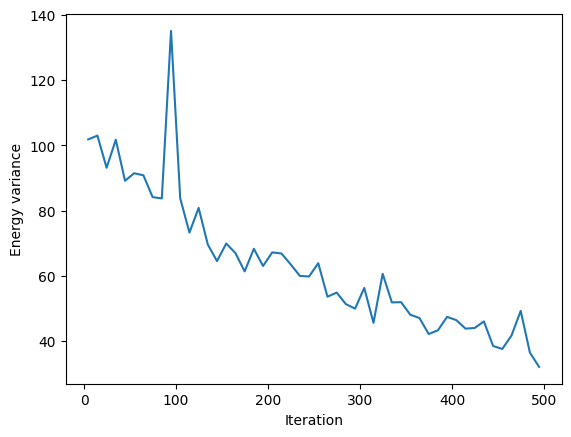
Here we show how to optimize the Gutzwiller-projected fermionic mean-field wavefunction. GeneralPfState is a subclass of Variational, so one can train it directly with SR.
mf_state = qtx.state.GeneralPfState(max_parallel=32768)
sampler = qtx.sampler.SpinExchange(mf_state, 1024, n_neighbor=[1, 2])
optimizer = qtx.optimizer.SR(mf_state, H)

energy = qtx.utils.DataTracer()
VarE = qtx.utils.DataTracer()

for i in range(500):
    samples = sampler.sweep()
    step = optimizer.get_step(samples)
    mf_state.update(step * 1e-3)

    energy.append(optimizer.energy)
    VarE.append(optimizer.VarE)

energy.plot(batch=10, baseline=exact_energy)
plt.xlabel("Iteration")
plt.ylabel("Energy")
plt.show()
VarE.plot(batch=10)
plt.xlabel("Iteration")
plt.ylabel("Energy variance")
plt.show()
Standard Jastrow factor#
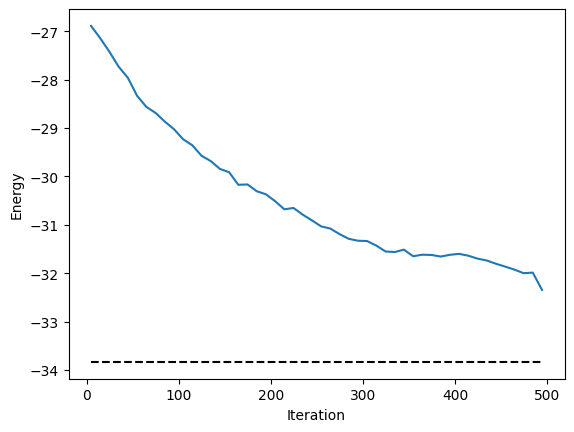
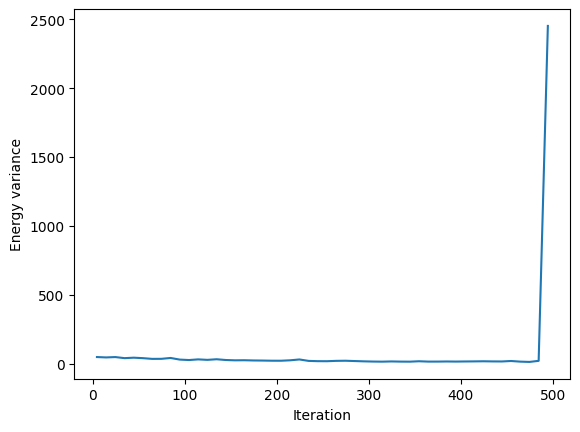
A standard Jastrow factor multiplies an existing wavefunction by a configuration-dependent weight,
where \(\psi_G(s)\) is the Gutzwiller-projected Pfaffian optimized above. The traditional two-body Jastrow factor Jastrow reads
with \(s_i = \pm 1\) and a symmetric coupling matrix \(W\) of variational parameters.
jastrow = qtx.model.Jastrow()
model = qtx.model.GeneralJastrow(net=jastrow, fermion_mf=mf_state.model)

state = qtx.state.Variational(model, max_parallel=16384)
sampler = qtx.sampler.SpinExchange(state, 1024, n_neighbor=[1, 2])
optimizer = qtx.optimizer.SR(state, H)

energy = qtx.utils.DataTracer()
VarE = qtx.utils.DataTracer()

for i in range(500):
    samples = sampler.sweep()
    step = optimizer.get_step(samples)
    state.update(step * 5e-4)

    energy.append(optimizer.energy)
    VarE.append(optimizer.VarE)

energy.plot(batch=10, baseline=exact_energy)
plt.xlabel("Iteration")
plt.ylabel("Energy")
plt.show()
VarE.plot(batch=10)
plt.xlabel("Iteration")
plt.ylabel("Energy variance")
plt.show()
Neural Jastrow factor#
We can make the Jastrow factor far more expressive by replacing the simple two-body form with a neural network, keeping the same structure
where \(J(s)\) is now the neural Jastrow factor and \(\psi_G(s)\) is the Gutzwiller-projected fermionic wavefunction. We reuse the pre-trained Pfaffian model mf_state.model as a good initialization.
We utilize ResConv as the neural network. trans_symm=Identity() means the network output is not summed in the last layer, so the output is a matrix \(\mathbf{J}(s)\). Then we define GeneralJastrow with trans_symm=TransND(), which means the output is
where \(T_{ij}s\) is a translation of the original input \(s\). One can view this formula as a translation symmetrized form of \(\psi(s) = J(s) \psi_G(s)\).
net = qtx.model.ResConv(nblocks=2, channels=8, kernel_size=3, trans_symm=Identity())
model = qtx.model.GeneralJastrow(net, mf_state.model, trans_symm=TransND())
Then one can perform the usual SR optimization on this wavefunction.
state = qtx.state.Variational(model, max_parallel=16384)

sampler = qtx.sampler.SpinExchange(state, 1024, n_neighbor=[1, 2])
optimizer = qtx.optimizer.SR(state, H)
energy = qtx.utils.DataTracer()
VarE = qtx.utils.DataTracer()

for i in range(500):
    samples = sampler.sweep()
    step = optimizer.get_step(samples)
    state.update(step * 2e-3)

    energy.append(optimizer.energy)
    VarE.append(optimizer.VarE)

    if i % 10 == 0:
        clear_output(wait=True)
        energy.plot(batch=10, baseline=exact_energy)
        plt.xlabel("Iteration")
        plt.ylabel("Energy")
        plt.show()
        VarE.plot(batch=10)
        plt.xlabel("Iteration")
        plt.ylabel("Energy variance")
        plt.show()

state.save("/tmp/neural_jastrow.eqx")
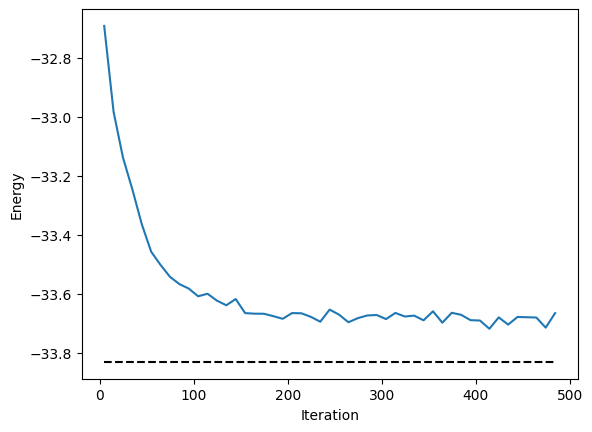
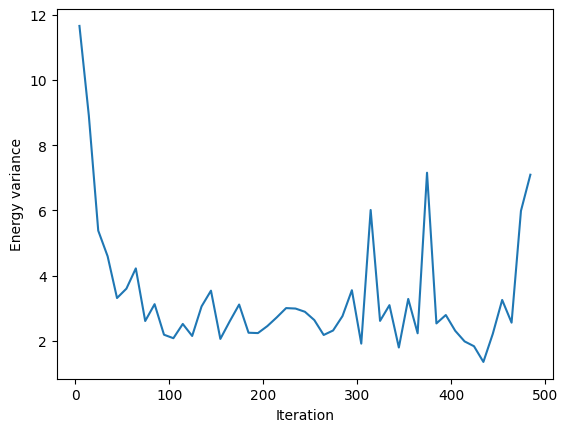
This state can also be symmetrized to achieve better accuracy.
symm = C4v() @ SpinInverse()
state = qtx.state.Variational(
    model, param_file="/tmp/neural_jastrow.eqx", symm=symm, max_parallel=2048
)

sampler = qtx.sampler.SpinExchange(state, 1024, n_neighbor=[1, 2])
optimizer = qtx.optimizer.SR(state, H)
energy = qtx.utils.DataTracer()
VarE = qtx.utils.DataTracer()

for i in range(200):
    samples = sampler.sweep()
    step = optimizer.get_step(samples)
    state.update(step * 2e-3)

    energy.append(optimizer.energy)
    VarE.append(optimizer.VarE)

    if i % 10 == 0:
        clear_output(wait=True)
        energy.plot(batch=10, baseline=exact_energy)
        plt.xlabel("Iteration")
        plt.ylabel("Energy")
        plt.show()
        VarE.plot(batch=10)
        plt.xlabel("Iteration")
        plt.ylabel("Energy variance")
        plt.show()

state.save("/tmp/neural_jastrow.eqx")
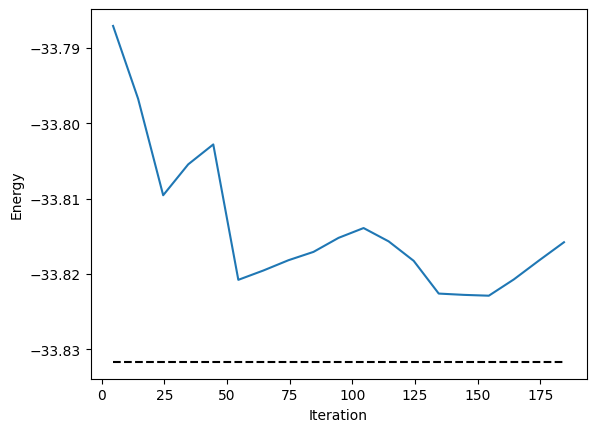
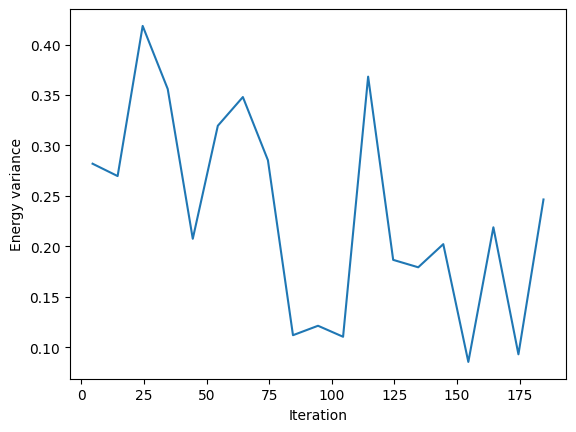
Then we can check its accuracy against the exact ground state.
dense = state.todense(full_symm).normalize()

E = dense @ H @ dense
rel_err = abs(E - exact_energy) / abs(exact_energy)
print("Relative energy error:", jnp.asarray(rel_err))

fidelity = abs(dense @ exact_state) ** 2
print("Fidelity with exact ground state:", jnp.asarray(fidelity))
Relative energy error: 0.0003117542913034912
Fidelity with exact ground state: 0.9991177383591362