Exact diagonalization#
Quantax wraps QuSpin to provide a simple interface of exact diagonalization (ED). In this tutorial, we show how to perform ED to obtain eigenstates of the Heisenberg model in Quantax. You will find it very convenient and fast!
Reference:
System definition#
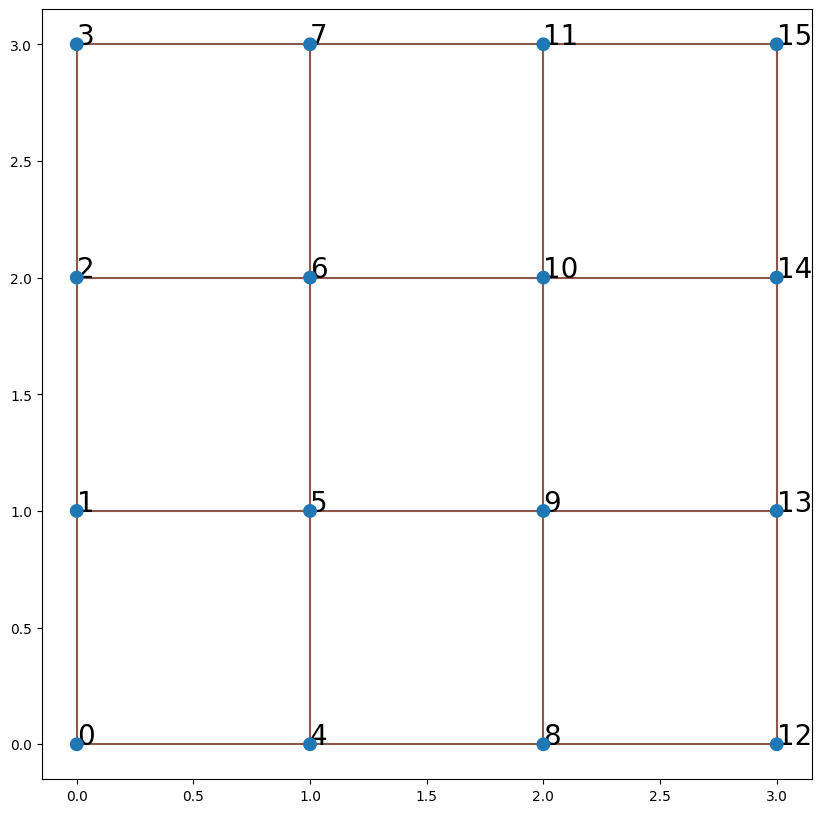
First, we define the lattice and Hilbert space of the problem, encoded in Lattice. We will use a small 4x4 lattice with periodic boundary condition (PBC). The Heisenberg model has a conserved number of up and down spins, which should also be specified.
import quantax as qtx
import matplotlib.pyplot as plt

# 4x4 square lattice, PBC by default, 8 spin-up, 8 spin-down
lattice = qtx.sites.Square(4, Nparticles=(8, 8))

print(lattice.shape)  # output: (1, 4, 4), 1 spin per unit cell, and Lx = Ly = 4
lattice.plot()
plt.show()
(1, 4, 4)
Now we define the Heisenberg Hamiltonian
We use the last equation to avoid complex numbers in the Hamiltonian. It’s implemented as an instance of Operator in Quantax.
# Define Heisenberg Hamiltonian

# Method 1: Using built-in operator
H = qtx.operator.Heisenberg()


# Method 2: Customized operator
from quantax.operator import sigma_z, sigma_p, sigma_m

H = 0

Lx, Ly = lattice.shape[1:]
for x in range(Lx):
    for y in range(Ly):
        # Periodic boundary taken into account automatically
        H += sigma_z(x, y) @ sigma_z(x + 1, y) + sigma_z(x, y) @ sigma_z(x, y + 1)
        H += 2 * (sigma_m(x, y) @ sigma_p(x + 1, y) + sigma_p(x, y) @ sigma_m(x + 1, y))
        H += 2 * (sigma_m(x, y) @ sigma_p(x, y + 1) + sigma_p(x, y) @ sigma_m(x, y + 1))

print(H)
+4.0 Sᶻ₀ Sᶻ₄ +4.0 Sᶻ₀ Sᶻ₁ +4.0 Sᶻ₁ Sᶻ₅ +4.0 Sᶻ₁ Sᶻ₂ +4.0 Sᶻ₂ Sᶻ₆ +4.0 Sᶻ₂ Sᶻ₃ +4.0 Sᶻ₃ Sᶻ₇ +4.0 Sᶻ₃ Sᶻ₀ +4.0 Sᶻ₄ Sᶻ₈ +4.0 Sᶻ₄ Sᶻ₅ +4.0 Sᶻ₅ Sᶻ₉ +4.0 Sᶻ₅ Sᶻ₆ +4.0 Sᶻ₆ Sᶻ₁₀ +4.0 Sᶻ₆ Sᶻ₇ +4.0 Sᶻ₇ Sᶻ₁₁ +4.0 Sᶻ₇ Sᶻ₄ +4.0 Sᶻ₈ Sᶻ₁₂ +4.0 Sᶻ₈ Sᶻ₉ +4.0 Sᶻ₉ Sᶻ₁₃ +4.0 Sᶻ₉ Sᶻ₁₀ +4.0 Sᶻ₁₀ Sᶻ₁₄ +4.0 Sᶻ₁₀ Sᶻ₁₁ +4.0 Sᶻ₁₁ Sᶻ₁₅ +4.0 Sᶻ₁₁ Sᶻ₈ +4.0 Sᶻ₁₂ Sᶻ₀ +4.0 Sᶻ₁₂ Sᶻ₁₃ +4.0 Sᶻ₁₃ Sᶻ₁ +4.0 Sᶻ₁₃ Sᶻ₁₄ +4.0 Sᶻ₁₄ Sᶻ₂ +4.0 Sᶻ₁₄ Sᶻ₁₅ +4.0 Sᶻ₁₅ Sᶻ₃ +4.0 Sᶻ₁₅ Sᶻ₁₂ +2.0 S⁻₀ S⁺₄ +2.0 S⁻₀ S⁺₁ +2.0 S⁻₁ S⁺₅ +2.0 S⁻₁ S⁺₂ +2.0 S⁻₂ S⁺₆ +2.0 S⁻₂ S⁺₃ +2.0 S⁻₃ S⁺₇ +2.0 S⁻₃ S⁺₀ +2.0 S⁻₄ S⁺₈ +2.0 S⁻₄ S⁺₅ +2.0 S⁻₅ S⁺₉ +2.0 S⁻₅ S⁺₆ +2.0 S⁻₆ S⁺₁₀ +2.0 S⁻₆ S⁺₇ +2.0 S⁻₇ S⁺₁₁ +2.0 S⁻₇ S⁺₄ +2.0 S⁻₈ S⁺₁₂ +2.0 S⁻₈ S⁺₉ +2.0 S⁻₉ S⁺₁₃ +2.0 S⁻₉ S⁺₁₀ +2.0 S⁻₁₀ S⁺₁₄ +2.0 S⁻₁₀ S⁺₁₁ +2.0 S⁻₁₁ S⁺₁₅ +2.0 S⁻₁₁ S⁺₈ +2.0 S⁻₁₂ S⁺₀ +2.0 S⁻₁₂ S⁺₁₃ +2.0 S⁻₁₃ S⁺₁ +2.0 S⁻₁₃ S⁺₁₄ +2.0 S⁻₁₄ S⁺₂ +2.0 S⁻₁₄ S⁺₁₅ +2.0 S⁻₁₅ S⁺₃ +2.0 S⁻₁₅ S⁺₁₂ +2.0 S⁺₀ S⁻₄ +2.0 S⁺₀ S⁻₁ +2.0 S⁺₁ S⁻₅ +2.0 S⁺₁ S⁻₂ +2.0 S⁺₂ S⁻₆ +2.0 S⁺₂ S⁻₃ +2.0 S⁺₃ S⁻₇ +2.0 S⁺₃ S⁻₀ +2.0 S⁺₄ S⁻₈ +2.0 S⁺₄ S⁻₅ +2.0 S⁺₅ S⁻₉ +2.0 S⁺₅ S⁻₆ +2.0 S⁺₆ S⁻₁₀ +2.0 S⁺₆ S⁻₇ +2.0 S⁺₇ S⁻₁₁ +2.0 S⁺₇ S⁻₄ +2.0 S⁺₈ S⁻₁₂ +2.0 S⁺₈ S⁻₉ +2.0 S⁺₉ S⁻₁₃ +2.0 S⁺₉ S⁻₁₀ +2.0 S⁺₁₀ S⁻₁₄ +2.0 S⁺₁₀ S⁻₁₁ +2.0 S⁺₁₁ S⁻₁₅ +2.0 S⁺₁₁ S⁻₈ +2.0 S⁺₁₂ S⁻₀ +2.0 S⁺₁₂ S⁻₁₃ +2.0 S⁺₁₃ S⁻₁ +2.0 S⁺₁₃ S⁻₁₄ +2.0 S⁺₁₄ S⁻₂ +2.0 S⁺₁₄ S⁻₁₅ +2.0 S⁺₁₅ S⁻₃ +2.0 S⁺₁₅ S⁻₁₂
Direct ED#
Then we use ED to obtain 2 lowest eigenstates of H, which is internally performed by QuSpin.
In Quantax, we implement DenseState to process dense wavefunctions.
E, wf = H.diagonalize(k=2)

dense0 = qtx.state.DenseState(wf[:, 0])  # Ground state
dense1 = qtx.state.DenseState(wf[:, 1])  # First excited state
One can easily compute the wavefunction amplitude \(\psi(s) = \left<s|\psi\right>\) from
DenseState.
s = qtx.utils.rand_states()
print("s =", s)  # +1/-1 represents spin-up/down
print("<s|psi0> =", dense0(s))
s = [ 1 -1 -1  1  1 -1 -1  1  1 -1 -1  1  1 -1  1 -1]
<s|psi0> = [0.00286137]
There are convenient expressions to compute \(\left<\psi|\phi\right>\) and \(\left<\psi|H|\psi\right>\).
print("<psi0|psi0> =", dense0 @ dense0)  # output: 1, normalization
print("<psi0|psi1> =", dense0 @ dense1)  # output: 0, orthogonality

print("<psi0|H|psi0> =", dense0 @ H @ dense0, "\t", "E0 =", E[0])
print("<psi1|H|psi1> =", dense1 @ H @ dense1, "\t", "E1 =", E[1])
<psi0|psi0> = 1.000000238418579
<psi0|psi1> = 2.9802322387695312e-08
<psi0|H|psi0> = -44.91394805908203 	 E0 = -44.91396
<psi1|H|psi1> = -42.59954833984375 	 E1 = -42.599525
One can also measure customized observables from the ED results. Here we show the spin-spin correlation as an example. The spin-spin correlation is defined as
def correlation(i, j):
    # sigma_z(x, y) and sigma_z(i) with i=4x+y are equivalent in 4x4 lattice
    return (
        sigma_z(i) @ sigma_z(j)
        + 2 * sigma_p(i) @ sigma_m(j)
        + 2 * sigma_m(i) @ sigma_p(j)
    ) / 4

C1 = correlation(0, 1)
C2 = correlation(0, 2)

print("<C01> =", dense0 @ C1 @ dense0)
print("<C02> =", dense0 @ C2 @ dense0)
<C01> = -0.3508901596069336
<C02> = 0.21376532316207886
ED with symmetries#
A common trick in ED is reducing the Hilbert space dimension using Symmetry.
In the square lattice Heisenberg model, the system is invariant under translation,
rotation, mirror flip, and spin inversion (Z2 spin-flip symmetry).
from quantax.symmetry import TransND, C4v, SpinInverse

# The symmetry superposition can be performed by "@"
symm = TransND() @ C4v() @ SpinInverse()

# We will get "GeneralBasisWarning" from QuSpin, but it doesn't matter here
E0_symm, wf0_symm = H.diagonalize(symm)
dense0_symm = qtx.state.DenseState(wf0_symm, symm)
/home/aochen/quantax/quantax/symmetry/symmetry.py:330: GeneralBasisWarning: using non-commuting symmetries can lead to unwanted behaviour of general basis, make sure that quantum numbers are invariant under non-commuting symmetries!
  basis = spin_basis_general(
The wavefunction is identical to the unsymmetrized one up to a possible extra minus sign, and the measurement gives the same result.
print("E0 =", E0_symm)
print("Check overlap:", dense0_symm @ dense0)
print("<s|psi0> =", dense0_symm(s))
print("<psi0|H|psi0> =", dense0_symm @ H @ dense0_symm)
E0 = [-44.913918]
Check overlap: 1.000000238418579
<s|psi0> = [0.00286139]
<psi0|H|psi0> = -44.9139404296875
However, be careful that some operators like the spin-spin correlation \(C_{ij}\) are ill-defined in the symmetrized Hilbert space. One cannot directly measure them in this case.
print("Wrong <C01>:", dense0_symm @ C1 @ dense0_symm)
print("Wrong <C02>:", dense0_symm @ C2 @ dense0_symm)
Wrong <C01>: 0.1507401168346405
Wrong <C02>: 0.2371429204940796
One can obtain the excited state as the ground state in a specific symmetry sector. Here we compute the triplet excitation energy with -1 eigenvalue under spin inversion.
spin_inv = SpinInverse(-1)

E1_symm, wf1_symm = H.diagonalize(spin_inv)
print("Excited state energy =", E1_symm)  # It's the first excited state shown above

dense1_symm = qtx.state.DenseState(wf1_symm, spin_inv)
print("Check overlap:", dense1_symm @ dense1)
Excited state energy = [-42.59954]
Check overlap: 0.9999999403953552