Real-time dynamics#
In this tutorial, we will discuss how to use Quantax to simulate real-time dynamics \(\ket{\dot \psi} = -i H \ket{\psi}\) in a \(4 \times 4\) transverse-field Ising model.
We will start from a product state \(\ket{\psi_0} = (\ket{\uparrow} + \ket{\downarrow})^{\otimes N}\), and simulate the quench dynamics under the Ising Hamiltonian.
import numpy as np
import matplotlib.pyplot as plt
import jax
import jax.numpy as jnp
import equinox as eqx
import quantax as qtx
from quantax.symmetry import TransND, C4v, SpinInverse
from IPython.display import clear_output
%config InlineBackend.figure_format = 'svg'

qtx.set_default_dtype(jnp.complex128)

lattice = qtx.sites.Square(4)
N = lattice.Nsites

H = qtx.operator.Ising(h=6)
Exact evolution#
In small systems, one can utilize QuSpin to obtain the exact evolution trajectory.
We start with the initial product state \(\ket{\psi_0}\). To reduce the cost of evolution, it’s usually important to restrict the state into a specific symmetry sector.
psi0 = np.ones((1 << N,), dtype=jnp.complex128)
psi0 = qtx.state.DenseState(psi0)

symm = TransND() @ C4v() @ SpinInverse()
psi0 = psi0.todense(symm).normalize()
/home/aochen/quantax/quantax/symmetry/symmetry.py:330: GeneralBasisWarning: using non-commuting symmetries can lead to unwanted behaviour of general basis, make sure that quantum numbers are invariant under non-commuting symmetries!
  basis = spin_basis_general(
Then we perform the evolution using a QuSpin operator. It will take some time.
op = H.get_quspin_op(symm)
t0 = 0.0
times = np.linspace(0, 1, 1001)

psit = op.evolve(psi0.psi, t0, times)
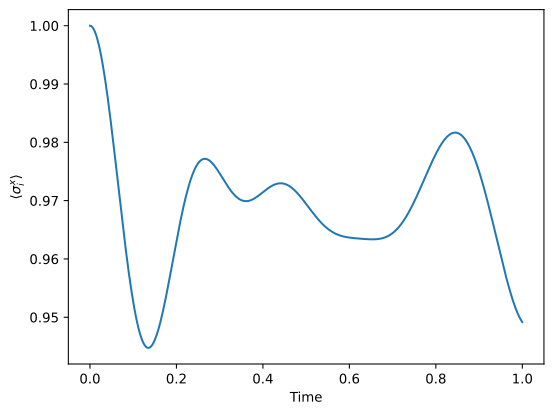
Now we can measure the evolution of \(\braket{\sigma_i^x}\).
from quantax.operator import sigma_x

opx = sum(sigma_x(i) for i in range(N)) / N
psit = [qtx.state.DenseState(psi, symm=symm) for psi in psit.T]
sx_exact = [psi @ opx @ psi for psi in psit]
sx_exact = np.asarray(sx_exact).real
plt.plot(times, sx_exact)
plt.xlabel('Time')
plt.ylabel(r'$\langle \sigma_i^x \rangle$')
plt.show()
NQS preparation#
The first step of neural-network unitary dynamics is also preparing an initial state. It’s hard to set the wavefunction amplitudes directly in an NQS. Here, we prepare the initial state by searching for the ground state of \(H_0 = -\sum_i \sigma_i^x\).
We will use ResConv as the variational wavefunction, which has been used in the tutorials of square and triangular J1-J2 models.
model = qtx.model.ResConv(
    nblocks=2, channels=8, kernel_size=3, dtype=jnp.float32, out_dtype=jnp.complex128
)
# Translation symmetry is encoded in ResConv, so it's not needed here
symm1 = C4v() @ SpinInverse()

state = qtx.state.Variational(model, symm=symm1)
sampler0 = qtx.sampler.LocalFlip(state, 1024)
optimizer = qtx.optimizer.SR(state, -opx)

sx = qtx.utils.DataTracer()

for i in range(100):
    samples = sampler0.sweep()
    step = optimizer.get_step(samples)
    state.update(step * 0.1)
    sx.append(-optimizer.energy)

sx.plot()
plt.show()

state.save("/tmp/dynamics.eqx")
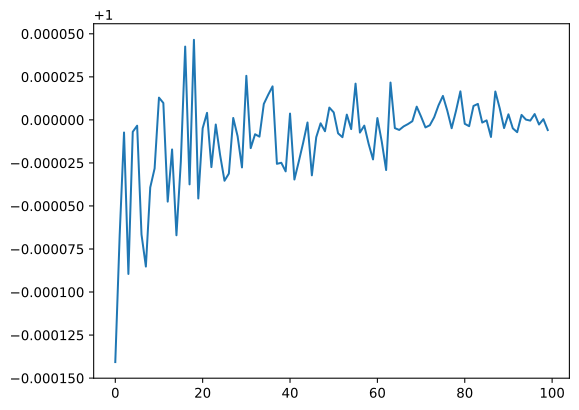
In practice, the choice of the initial state \(\ket{\psi_0}\) depends on the physical background. For instance, \(\ket{\psi_0}\) can be an excitation of a ground state if one needs to study low-energy spectrum.
Non-stochastic TDVP#
The method simulating unitary dynamics with variational wavefunctions is called time-dependent variational principle (TDVP). We start with non-stochastic TDVP supported by ER. As explained in Build your network, it’s restricted to small systems and helps us to check the expressivity of neural networks by excluding stochastic errors.
Assume the evolution trajectory is determined by
where \(\theta\) denotes the variational parameters. In ground-state search, one updates \(\theta\) to first order, i.e.
In unitary dynamics, one has to employ higher order updates to ensure accuracy in every step. We will utilize Heun’s method given by
Choosing the linear solver#
Each TDVP step solves a linear equation \(S \dot\theta = F\), where the quantum geometric tensor \(S\) — assembled from the Jacobian \(\frac{1}{\psi}\frac{\partial \psi}{\partial \theta}\) — is typically ill-conditioned, with many tiny, nearly-degenerate eigenvalues. The solver argument controls how this near-singular system is regularized.
The default solver of ER is auto_shift_eig(), which regularizes by a diagonal shift \(S \to S + \epsilon I\). This is robust and convenient for ground-state optimization, but the shift biases every update and accumulates error along a long real-time trajectory. For dynamics we instead pass auto_pinv_eig(), a pseudo-inverse that effectively truncates the eigenvalues below a tolerance rather than shifting all of them, giving a more faithful evolution direction.
state = qtx.state.Variational(model, "/tmp/dynamics.eqx", symm=symm1)
solver = qtx.optimizer.auto_pinv_eig()
optimizer = qtx.optimizer.ER(state, H, imag_time=False, symm=symm, solver=solver)

dt = 0.001

fidelity = qtx.utils.DataTracer()
sx_etdvp = qtx.utils.DataTracer()

for i in range(1, 1001):
    step1 = optimizer.get_step()
    state.update(step1 * dt)
    step2 = optimizer.get_step()
    state.update((step2 - step1) * dt / 2)

    if i % 10 == 0:
        clear_output(wait=True)
        dense = state.todense(symm).normalize()
        fidelity.append(abs(dense @ psit[i]) ** 2, time=i * dt)
        sx_etdvp.append((dense @ opx @ dense).real, time=i * dt)

        fidelity.plot()
        plt.xlabel('Time')
        plt.ylabel('Fidelity')
        plt.show()

        plt.plot(times, sx_exact, 'k--')
        sx_etdvp.plot()
        plt.xlabel('Time')
        plt.ylabel(r'$\langle \sigma_i^x \rangle$')
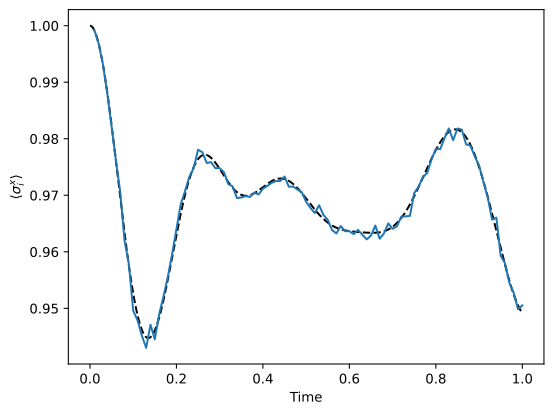
        plt.show()
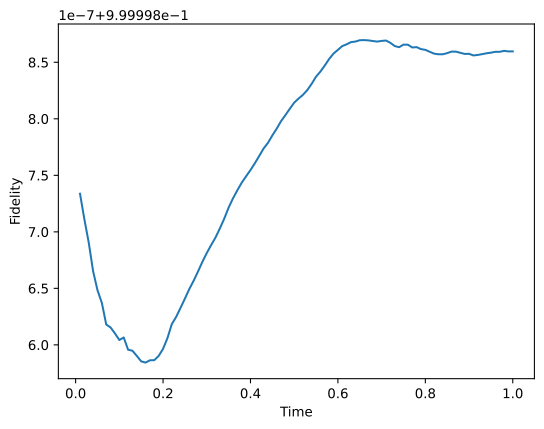
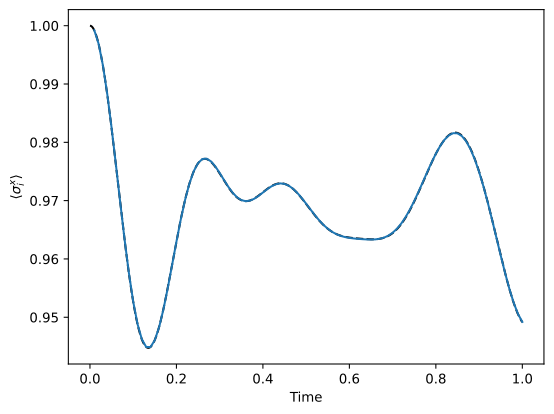
The fidelity is high during the evolution, and \(\braket{\sigma_i^x}\) matches well with the exact values. These results show that ResConv has enough expressivity for the dynamics.
Stochastic TDVP#
Next, we will introduce stochastic evolution supported by TimeEvol, which is equivalent to real-time SR but tailored for the simulation of unitary dynamics (samples more than parameters).
Note that TimeEvol already uses a pseudo-inverse solver (pinvh_solve()) by default, so the explicit solver choice above is not needed here.
state = qtx.state.Variational(model, "/tmp/dynamics.eqx", symm=symm1)
sampler = qtx.sampler.LocalFlip(
    state, nsamples=8192, thermal_steps=50 * N, sweep_steps=5 * N
)
optimizer = qtx.optimizer.TimeEvol(state, H)

dt = 0.001

sx_stdvp = qtx.utils.DataTracer()

for i in range(1, 1001):
    samples = sampler.sweep()
    step1 = optimizer.get_step(samples)
    state.update(step1 * dt)

    samples = sampler.sweep()
    step2 = optimizer.get_step(samples)
    state.update((step2 - step1) * dt / 2)

    if i % 10 == 0:
        clear_output(wait=True)
        sx_stdvp.append(opx.expectation(state, samples).real, time=i * dt)

        plt.plot(times, sx_exact, "k--")
        sx_stdvp.plot()
        plt.xlabel("Time")
        plt.ylabel(r"$\langle \sigma_i^x \rangle$")
        plt.show()

    if i % 50 == 0:
        # Reset all Markov chains to improve sampling quality
        sampler.reset()