Caltech

Ao Chen 陈骜

Role
Postdoctoral researcher
Since
May 2025

Research interests

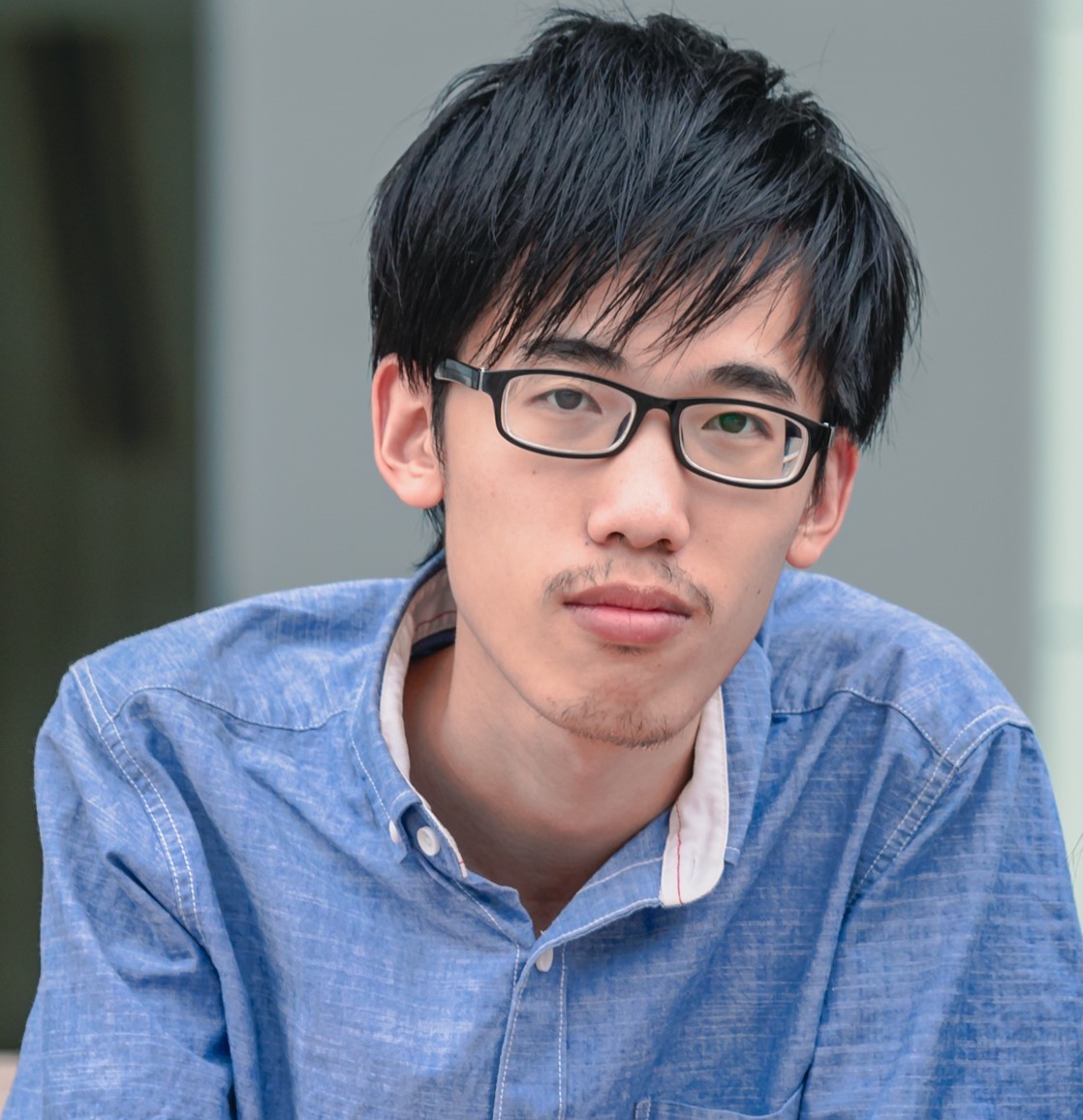
Portrait of Ao Chen

NQS roadmap to high-Tc superconductors

  • Achieved
  • Projected

Milestone 0 · Achieved · June 2016 · The field

NQS proposed

Carleo and Troyer encode the quantum many-body wavefunction in an artificial neural network and optimize it variationally — the birth of neural quantum states.

  1. G. Carleo, M. Troyer

    Solving the quantum many-body problem with artificial neural networks

    Science 355, 602 (2017)

    Paper (Science, 2017)

Milestone 1 · Achieved · June 2019 · The field

Neural-network backflow

Luo and Clark let a neural network dress the orbitals of a Slater determinant with the positions of all other particles — a backflow transformation that carries neural quantum states from spins to strongly correlated fermions.

  1. D. Luo, B. K. Clark

    Backflow transformations via neural networks for quantum many-body wave functions

    Phys. Rev. Lett. 122, 226401 (2019)

    Paper (Phys. Rev. Lett., 2019)

Milestone 2 · Achieved · July 2024

Scalable NQS with more than 106 parameters

Until then, neural quantum states were limited to very few parameters. Chen and Heyl choose a suitable optimizer that trains large-scale networks efficiently, bringing neural quantum states into the deep-learning era, where they can truly surpass traditional numerical methods and reveal new physics.

  1. A. Chen, M. Heyl Own work

    Empowering deep neural quantum states through efficient optimization

    Nat. Phys. 20, 1476–1481 (2024)

    Paper (Nature Physics, 2024) Data & code (MinSR on GitHub)

Research highlight

Milestone 3 · Projected · 2027

First solid numerical evidence of high-Tc superconductivity in Hubbard-like models

It has long been proposed that high-Tc superconductivity can arise purely from electronic interactions, but numerical simulations have lacked the accuracy to confirm it. With the improving accuracy of neural quantum states, this hypothesis is expected to be credibly verified numerically.

Projected milestone — no publication yet.

Milestone 4 · Projected · 2028–2030

Validation of NQS against real-material Tc

Benchmark NQS predictions against the measured Tc of real materials.

Projected milestone — no publication yet.

Milestone 5 · Projected · 2030s

Search for a model with high Tc for materials design

Search model space for higher Tc and turn the best candidates into guidance for materials design.

Projected milestone — no publication yet.

Research highlights

Evidence for step 2

Nature Physics 20, 1476–1481 (2024)

Empowering deep neural quantum states through efficient optimization
Ao Chen, Markus Heyl

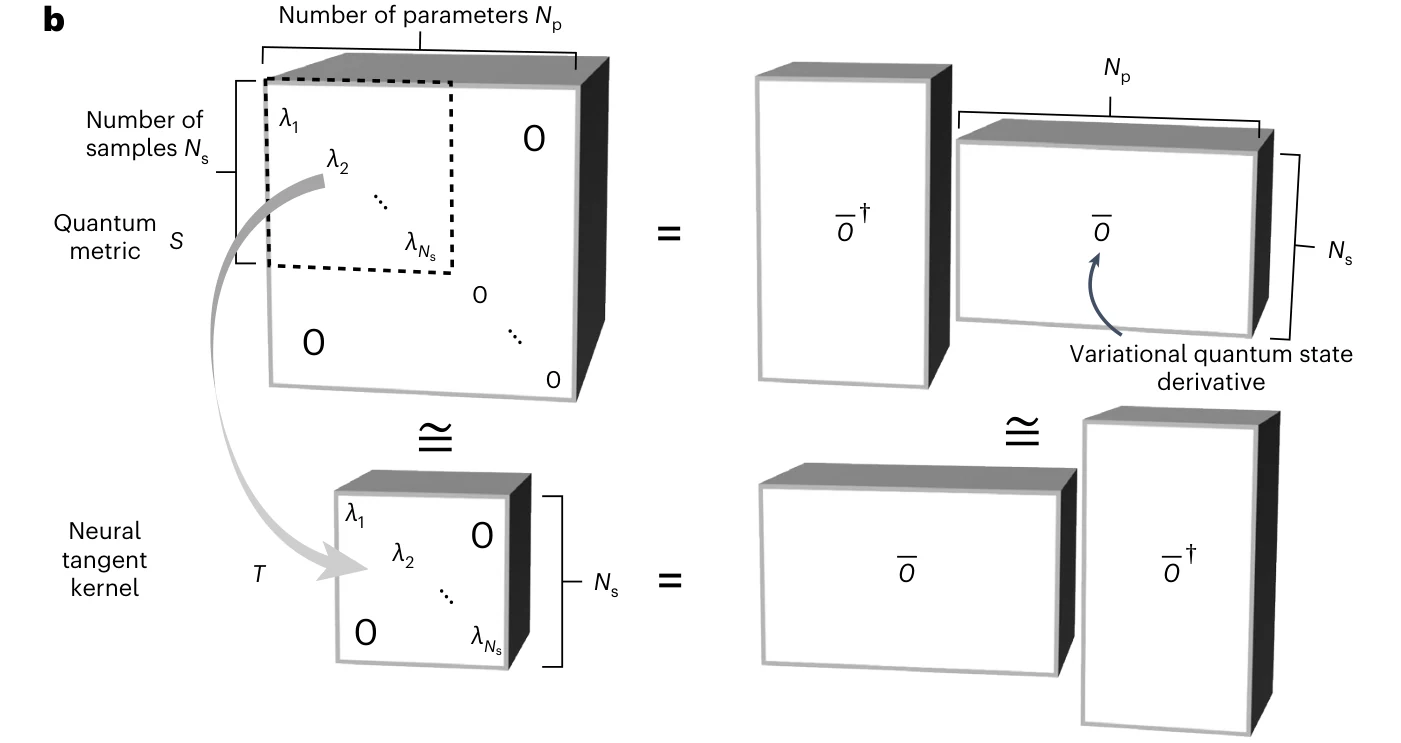
Schematic: the quantum metric S, an N_p by N_p matrix equal to O-dagger times O, has only N_s non-zero eigenvalues, which it shares with the much smaller N_s by N_s neural tangent kernel T equal to O times O-dagger.
Fig. 1b MinSR replaces the large quantum metric S with the much smaller neural tangent kernel T, which has the same non-zero eigenvalues. From the article (CC BY 4.0).

NQS has faced the critical limitation that existing optimization algorithms are not suitable for training modern large-scale deep network architectures. Here, we introduce a MinSR algorithm, which allows us to train deep neural quantum states with more than 106 parameters.
arXiv:2610.30321 (October 2026) Preprint

Extreme competition between stripes and superconductivity in the hole-doped Hubbard model

Ao Chen, Johnnie Gray, Si-Jing Du, Garnet Kin-Lic Chan

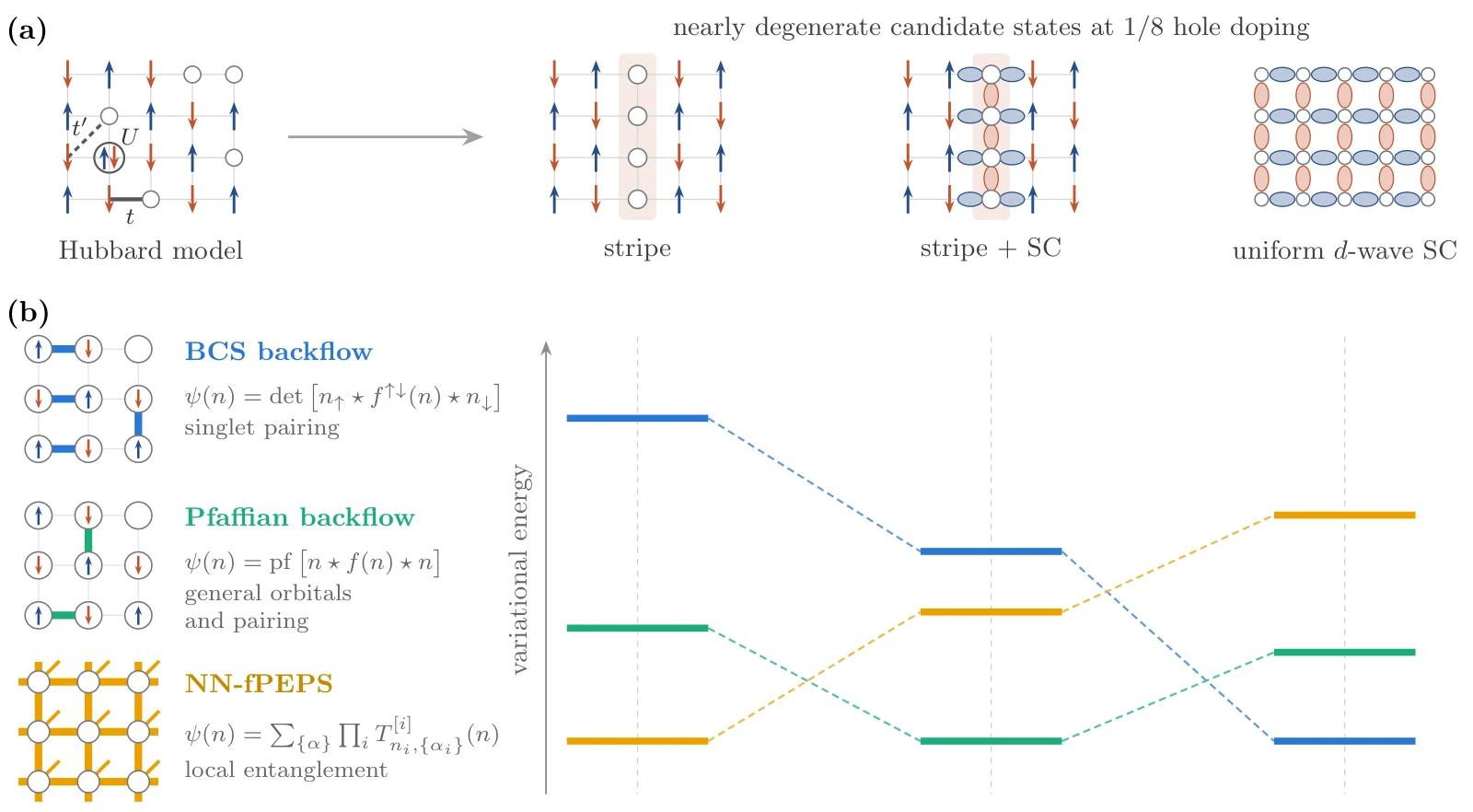
Top: the Hubbard model and three nearly degenerate candidate states at 1/8 hole doping: stripe, stripe plus superconductivity, and uniform d-wave superconductivity. Bottom: BCS backflow, Pfaffian backflow and NN-fPEPS ansätze, with a schematic of how each ansatz ranks the three states in variational energy.
Fig. 1 Nearly degenerate candidate states at 1/8 hole doping, and the bias each variational ansatz carries toward them.

The 2D Hubbard model is the candidate model for superconductivity in the cuprates, but recent calculations have often found other ground states. Further, uncertainty remains over such results due to the intrinsic bias of different computational methods. Here we address this uncertainty through state-of-the-art NQS simulations that reach an unprecedented variational accuracy on lattices with up to 1024 sites. At 1/8 doping in the pure Hubbard model, as well as with t′ = −0.2, we reveal a near degeneracy among a low-energy uniform d-wave state, superconducting stripes, and non-superconducting stripe states.

arXiv:2611.26604 (November 2026) Preprint

Scalable Simulation of Strongly Correlated Fermions with Neural Gaussian Tensor Networks

Runze Chi, Ao Chen, Garnet Kin-Lic Chan

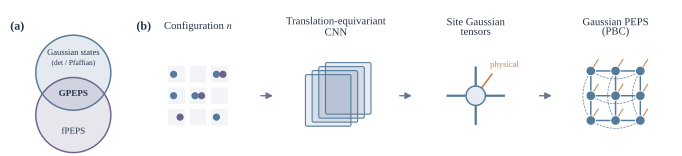
Left: Gaussian PEPS drawn as the intersection of Gaussian states and fermionic PEPS. Right: a translation-equivariant convolutional neural network with circular padding maps an occupation configuration to local pairing matrices, which define Gaussian site tensors on a periodic lattice.
Fig. 1 Construction of NN-GPEPS: a CNN maps each occupation configuration to the local Gaussian tensors of a fermionic PEPS, which can be contracted exactly at O(N3/2) cost.

We introduce neural-network Gaussian PEPS (NN-GPEPS), which exploit the locally-entangled subspace of Gaussian states to give an architecture more compatible with modern neural networks and an exact contraction cost of O(N3/2) on 2D lattices. For the Hubbard model at U/t = 8 and 1/8 hole doping, we obtain state-of-the-art variational energies in large lattices of up to 1024 sites.

Experience

Software

  • quantax

    Flexible and scalable neural quantum states in JAX.
    Documentation

  • lrux

    Fast low-rank updates (LRU) of matrix determinants and Pfaffians in JAX.
    Documentation · Paper

  • fermix

    Fast batched determinants and Pfaffians on GPU with JAX/Pallas kernels.

I have also contributed to QuSpin, Equinox, autoray, and symmray.

Publications

2026

  1. 01

    Runze Chi, Ao Chen, Garnet Kin-Lic Chan

    Scalable Simulation of Strongly Correlated Fermions with Neural Gaussian Tensor Networks

    arXiv:2611.26604 (2026) · Data & code Preprint

  2. 02

    Ao Chen, Johnnie Gray, Si-Jing Du, Garnet Kin-Lic Chan

    Extreme competition between stripes and superconductivity in the hole-doped Hubbard model

    arXiv:2610.30321 (2026) · Data & code Preprint

  3. 03

    Si-Jing Du, Johnnie Gray, Ao Chen, Garnet Kin-Lic Chan

    Vectorized Symmetric and Fermionic Tensor Network Implementations for GPU-Accelerated Variational Monte Carlo

    arXiv:2608.27861 (2026) Preprint

  4. 04

    Hannah Lange, Ao Chen, Antoine Georges, Fabian Grusdt, Annabelle Bohrdt, Christopher Roth

    Simulating superconductivity in mixed-dimensional t∥-J∥-J⊥ bilayers with neural quantum states

    arXiv:2602.10091 (2026) Preprint

  5. 05

    Ao Chen, Christopher Roth

    lrux: Fast low-rank updates of determinants and Pfaffians in JAX

    arXiv:2602.05255 (2026) Preprint

  6. 06

    Yinzhanghao Zhou, Tsung-Han Lee, Ao Chen, Nicola Lanatà, Hong Guo

    Neural-Quantum-States Impurity Solver for Quantum Embedding Problems

    Phys. Rev. B 113, 155123 (2026)

  7. 07

    Ao Chen, Zhou-Quan Wan, Anirvan Sengupta, Antoine Georges, Christopher Roth

    Neural Network-Augmented Pfaffian Wave-functions for Scalable Simulations of Interacting Fermions

    Proc. Natl. Acad. Sci. U.S.A. 123(35), e2535288123 (2026)

  8. 08

    Si-Jing Du, Ao Chen, Garnet Kin-Lic Chan

    Neuralized Fermionic Tensor Networks for Quantum Many-Body Systems

    Phys. Rev. B 113, 085134 (2026)

  9. 09

    Ao Chen*, Vighnesh Dattatraya Naik*, Markus Heyl

    Convolutional transformer wave functions

    Phys. Rev. Research 8, L022040 (2026) * equal contribution

2025

  1. 10

    Christopher Roth, Ao Chen, Anirvan Sengupta, Antoine Georges

    Superconductivity in the two-dimensional Hubbard model revealed by neural quantum states

    arXiv:2511.07566 (2025) Preprint

  2. 11

    Ao Chen

    Large-scale simulation of deep neural quantum states

    PhD thesis, University of Augsburg (2025) Thesis

2024

  1. 12
    A. O. Scheie, Minseong Lee, Kevin Wang, … Ao Chen, Vivien S. Zapf, Markus Heyl, … D. Alan Tennant
    Show all 21 authors A. O. Scheie, Minseong Lee, Kevin Wang, P. Laurell, E. S. Choi, D. Pajerowski, Qingming Zhang, Jie Ma, H. D. Zhou, Sangyun Lee, Chao Huan, S. M. Thomas, M. O. Ajeesh, P. F. S. Rosa, Ao Chen, Vivien S. Zapf, Markus Heyl, Cristian D. Batista, Elbio Dagotto, Joel E. Moore, D. Alan Tennant

    Spectrum and low-temperature bulk properties of triangular quantum spin liquid candidate NaYbSe2

    arXiv:2406.17773 (2024) Preprint

  2. 13

    Hongzheng Zhao, Ao Chen, Shu-Wei Liu, Marin Bukov, Markus Heyl, Roderich Moessner

    Learning effective Hamiltonians for adaptive time-evolution quantum algorithms

    arXiv:2406.06198 (2024) Preprint

  3. 14

    Ao Chen, Markus Heyl

    Empowering deep neural quantum states through efficient optimization

    Nature Physics 20, 1476–1481 (2024) · Data & code

Earlier

  1. 15

    Ao Chen, Kenny Choo, Nikita Astrakhantsev, Titus Neupert

    Neural network evolution strategy for solving quantum sign structures

    Phys. Rev. Research 4, L022026 (2022)

  2. 16

    Nikita Astrakhantsev, Tom Westerhout, Apoorv Tiwari, Kenny Choo, Ao Chen, Mark H. Fischer, Giuseppe Carleo, Titus Neupert

    Broken-symmetry ground states of the Heisenberg model on the pyrochlore lattice

    Phys. Rev. X 11, 041021 (2021)

  3. 17

    Yuting Lou, Ao Chen, Erika Yoshida, Yu Chen

    Homeostasis and systematic ageing as non-equilibrium phase transitions in computational multicellular organizations

    R. Soc. Open Sci. 6, 190012 (2019)

Full citation record on Google Scholar

Contact

chenao.phys@gmail.com

Pasadena, California